

Marketing Tips
AI SEO Strategy for Small Business: The 2026 Playbook
Five moves that actually shift AI visibility, a 90-day plan you can start on Monday, and the things worth ignoring.
The short answer:
An AI SEO strategy means two different things and you need both. The first is using AI tools to do your SEO faster, for keyword research, competitor analysis and first drafts. The second is optimizing so AI search itself quotes you, in Google’s AI Overviews, ChatGPT and Gemini. For a small business the second matters more, and most of it comes down to answering your customers’ real questions in plain language.
If you’ve searched this term you’ve probably noticed the confusion already. Half the results sell you software. The other half talk about showing up in ChatGPT. Nobody says out loud that these are different jobs, which makes the whole subject harder to act on than it needs to be.
You don’t need forty tools and you don’t need to panic about AI eating your traffic. What you need is a short list of things that actually move visibility, in the right order, written for a business that answers its own phone.
This is that list, covering both meanings, and by the end you’ll have a 90-day plan you can start on Monday without buying anything.
The two meanings of AI SEO
Before anything else, untangle the term. It is used for two separate jobs and the advice for each is different.
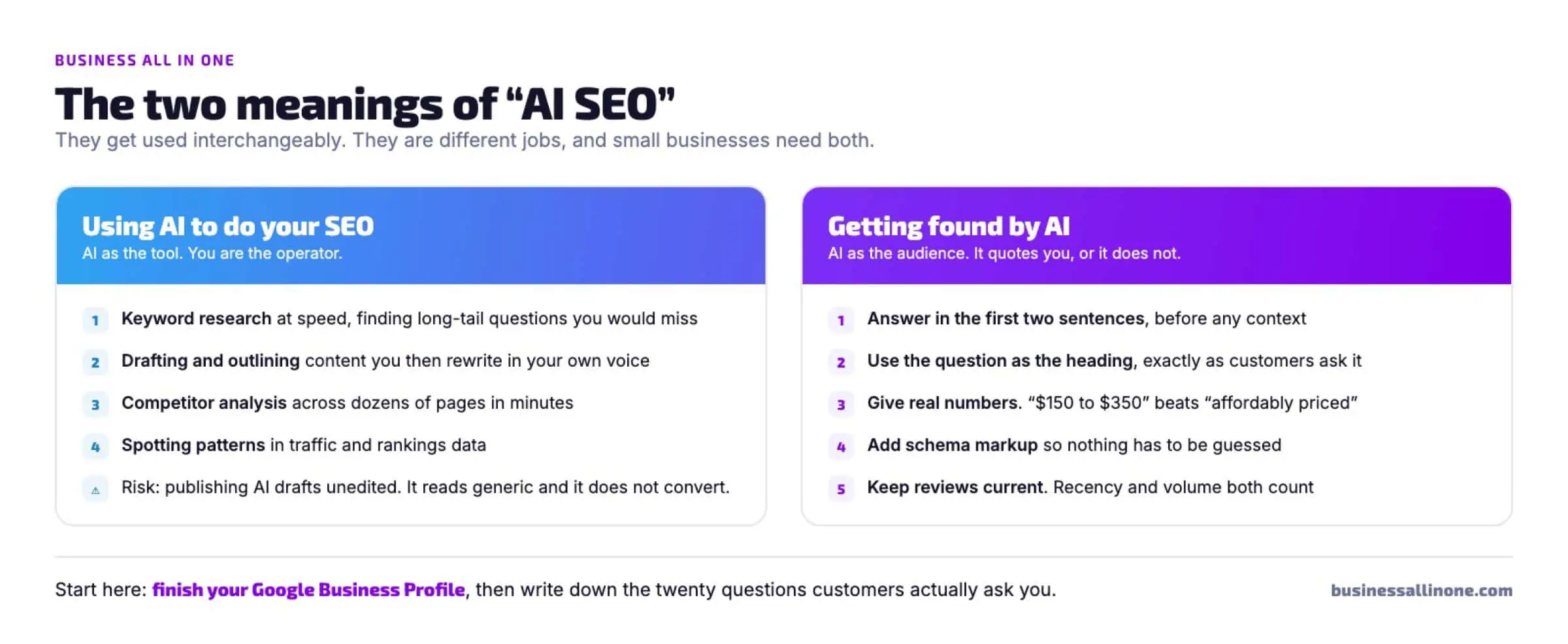
Using AI to do your SEO is AI as a tool. It shortens keyword research, reads competitor pages faster than you can, drafts outlines and spots patterns in your traffic data. It saves hours and it changes nothing about how Google ranks you.
Getting found by AI is AI as the audience. Your content either gets quoted inside an answer or it does not. This is the one that changes what you publish, and for a local business it is the half that matters more.
Where people go wrong is assuming the first delivers the second. Generating forty articles with ChatGPT doesn’t make you quotable. It usually makes you less quotable, because unedited drafts say very little in a great many words and leave nothing specific to lift.
What AI is genuinely good at in your workflow
- Finding the questions you would miss. Ask it what customers ask before hiring your trade. You will recognise most, and the two or three you did not think of are worth a page each.
- Reading the competition. Paste in three competitor pages and ask what they cover that you do not. Minutes instead of an afternoon.
- First drafts and outlines, as raw material you rewrite. Never as the published page.
- Explaining your own data when a report says something you do not understand.
Where it costs you
Publishing unedited output is the obvious one. The subtler risk is accuracy: AI tools state prices, timelines and regulations for your trade with total confidence and get them wrong, and your name is on the page when a customer relies on it.
Our rule is simple. AI in the middle of the process, never at the start where the strategy lives and never at the end where your voice and the facts live.
What actually changes: pages become passages
Here is the part that actually matters. Traditional SEO ranks a page. AI systems quote a passage. That single shift explains almost every tactical difference that follows.
A page can earn its ranking through overall authority, internal links and relevance built across hundreds of words. A passage has to stand on its own. It gets lifted out of your page, dropped into an answer next to two or three other sources, and read by someone who will never see the rest of your writing.
So the question stops being “is my page about water heaters good enough to rank” and becomes “can any single paragraph on this page be pulled out, understood without context, and trusted enough to quote”.
That is a writing and structure problem. It isn’t a technology problem, and it doesn’t require new software.
It’s worth being clear about why an AI SEO strategy matters now rather than two years ago. Answer engines used to sit below the results. They now sit above them, and on plenty of questions they answer completely enough that nobody scrolls. Your page can hold position three and still be invisible to someone who reads the summary and stops.
That’s the actual risk, and it’s narrower than the headlines suggest. It applies to informational questions with tidy answers. It applies far less to somebody choosing who to call, which is where a local business earns.
Why most AI SEO advice doesn’t apply to your business
Read five articles on this topic and you will notice they assume things about your customers that are almost certainly not true.
They assume a long research cycle. Weeks of comparison, multiple stakeholders, a decision made from a spreadsheet. That describes buying software. It doesn’t describe someone whose basement is filling with water.
They assume informational search is where your revenue comes from. For a publisher or a SaaS company, it is. For a plumber, a dentist or a roofer, the money is in short commercial searches with obvious intent, and those have barely changed.
Three things follow from that, and they are the reason your strategy should look different.
Your customers ask shorter, more urgent questions. “Why is my water heater leaking” is an answer engine question. “Emergency plumber near me” isn’t. The first usually happens an hour before the second, which makes it worth owning, but don’t confuse the two.
The map pack has not changed. When somebody searches for a service near them, Google still returns local results driven by your Google Business Profile, your proximity to the searcher, your reviews and your citations. No amount of AI optimization moves that. If your profile is half finished, close this article and go fix it, because that’s worth more than everything below.
Being named can matter more than being clicked. When somebody asks an assistant to recommend a local company and yours is one of three named, that’s closer to a referral than to a search result. Nobody has good tooling to measure it, which is exactly why it’s undervalued at the moment.
Here is the contrast in one example. A software company writes a two thousand word comparison guide because their buyer reads for three weeks before deciding. A roofer needs a four hundred word page that says what storm damage repair costs, what insurance usually covers and how fast someone can get out there. Both can get cited. Only one of them matches how a roofing customer actually behaves, and most published AI SEO advice is written for the first.
The five moves that actually shift AI visibility
Ordered by return, not by how modern they sound. Most published lists start with tools, which is the least useful place to begin.
In order:
Finish your Google Business Profile. Write down the twenty questions customers ask you on the phone and answer each one in the first two sentences. Add FAQ, Service and LocalBusiness schema. Keep reviews arriving steadily. Make your key facts consistent across your site, your profile and your listings. Everything else is optimization on top of those five.
1. Finish your Google Business Profile
Every service listed, real photos rather than stock, accurate hours, questions answered, the occasional post. Assistants read your profile directly when someone asks for a local recommendation, and an incomplete profile is a weak source.
This costs nothing and takes an afternoon. It is still the highest-return hour a local business can spend, which is a slightly boring conclusion to reach in an article about artificial intelligence. See how to optimize your Google Business Profile for the detail.
2. Write down your twenty questions
You already know them. They are the questions customers ask on the phone before they book, and most owners have twenty memorised and none written down.
Each one becomes a heading. The answer goes in the first two sentences underneath, with specifics. Not “costs vary depending on your needs” but “usually $150 to $350, or $1,200 to $2,500 if the tank has corroded”.
This is the single highest-return content project available to a small business and it costs an afternoon of thinking.
A practical way to collect them: keep a note open for two weeks and write down every question a customer asks before booking. You will have twenty inside a fortnight and you will recognise most of them straight away. The ones that repeat are the ones worth a page.
Don’t group them. One question per heading, answered directly underneath, is what gets extracted. A page called “frequently asked questions about heating” with twelve answers buried in it competes worse than twelve short sections that each answer one thing plainly.
3. Add schema markup
Schema tells a parser what your page is instead of making it infer. For a local business, FAQ, Service and LocalBusiness markup do most of the work.
It is a one-time technical job with permanent benefit, and most small business websites simply don’t have it. If yours doesn’t, that’s a gap worth closing before you spend anything on content.
If you’re on WordPress, an SEO plugin handles most of it and the rest is a one-off job for whoever maintains your site. If you’re on a builder that won’t let you add structured data at all, that’s a genuine reason to consider moving, and close to the only one on this page.
4. Keep reviews current
Volume matters, recency matters more than people expect, and assistants asked to recommend a local business lean on both. A steady trickle beats forty reviews in one month followed by two silent years.
Review generation was already worth doing for the map pack. It now does double duty, which makes it the easiest thing on this list to justify.
5. Make your facts consistent
A claim repeated the same way across your website, your Google Business Profile and your review responses is safer to quote than one that appears once. Inconsistent hours, service areas or phone numbers do more damage than most owners realise, because they give a machine a reason to pick somebody else.
Practically, that means picking one canonical version of your facts and using it everywhere. One phone number format. One service area description. One list of what you actually do. Write it once, then make your site, your profile, your directory listings and your review responses agree with it.
What our clients say
Trusted by small businesses




Your 90-day AI SEO plan
Proposals are usually vague about sequence, which is how businesses end up three months in with nothing to point at. Here is the order we’d actually run it.
Days 1 to 30, foundation
Claim and finish the Google Business Profile completely. Install tracking so calls and forms are attributed properly. Audit your top ten pages and rewrite the opening two sentences of each so they answer directly. Add FAQ and LocalBusiness schema. Nothing here requires new content, which is why it comes first.
Days 31 to 60, content
Turn your twenty questions into real pages or real sections, one question per heading. Add Service schema as those pages go live. Switch on review generation properly, with a request that goes out after every completed job rather than when you remember.
Days 61 to 90, authority and pruning
Build links and citations, keep publishing answers, and prune. Cut what has produced nothing and move the effort to what has. This is also where you first test whether assistants name you, which is covered in the next section.
Two things are deliberately absent from that plan. There is no tool purchase, and there’s no site rebuild. Both are usually premature, and both are easier to sell than the work above.
If your site is genuinely old, slow or impossible to update, that changes the sequence and the rebuild comes first. That is a real situation and worth being honest about, but it’s less common than the people selling rebuilds suggest.
Two other situations change the order. If you have almost no reviews, move review generation into the first thirty days, because it feeds the map pack and the AI answers at once and takes weeks to accumulate. And if you’re in a genuinely competitive metro market, add paid search to the first thirty days too, because organic and AI visibility both take months and you’ll need something producing calls while they mature.
What shouldn’t change is the order of the first two weeks. Profile, then tracking, then your existing pages. Businesses that skip straight to publishing new content almost always find they can’t tell whether any of it worked.
What we’ve seen running this for local clients
We have been doing marketing for trades, home services and local practices since 2017. A few patterns have held up, and one of them surprised us.
The pages that get quoted are the boring ones. Not the polished service pages with the photography budget. The plain answer pages, the ones that state a price range and a cause and stop. That is uncomfortable if you have just paid for a redesign, but it’s consistent.
Specificity beats length every time. A four hundred word page that names actual numbers gets pulled into answers more often than a two thousand word page that circles the topic. The instinct to write more is usually wrong. The instinct to write plainer is usually right.
The profile does more than the website. For genuinely local queries, the Google Business Profile carries more weight than anything on the site. We have watched businesses move on profile work alone while their website stayed untouched.
What surprised us: the same rewrite that improves AI citation also improves conversion. When you answer the question in the first two sentences and give a real number, more people call. That should not be surprising, but it means this work pays even if the AI part turns out to be overhyped, which is the best kind of bet to make.
The businesses that struggle are the ones with nothing written down. If every answer a customer needs lives in the owner’s head or on the phone, there’s nothing for a search engine or an assistant to quote. That isn’t a technology gap. It’s a documentation gap, and it’s the most common thing we find when a site isn’t performing.
Our cleaning company case study documents one of these campaigns in full, including what was done in what order and the traffic and revenue changes that followed.
Which pages to fix first
You don’t need to touch the whole site. An AI SEO strategy works best applied narrowly, to the handful of pages that already have something going for them.
Pull your Search Console data and sort by impressions. The pages showing up often but converting poorly are your best candidates, because Google already understands what they’re about. They just aren’t written in a way anything can quote.
- Pages with impressions but no clicks. Google is showing them and nobody is choosing them. Usually the title promises nothing specific and the opening paragraph answers nothing. Rewriting the first two sentences is often enough to move them.
- Your top three service pages. These carry your commercial intent. They rarely need more words, they need a direct answer near the top and a real price or range somewhere on the page.
- Any page that already wins a featured snippet. If you own a snippet you’re already quotable, and that page is the template for the rest of your AI SEO work. Look at what it does and copy the structure.
- Your Google Business Profile description and services. Not a page, but it gets read more than most of your pages for local questions.
Leave the rest alone for now. Ten pages fixed properly will teach you more than eighty touched lightly, and you’ll be able to tell which change did the work.
One caution. Don’t rewrite a page that is currently ranking well and converting. The temptation to “optimize” a winner is strong and it is how businesses lose rankings they already had. If it works, document why and apply that pattern elsewhere.
How to tell if it’s working
This is where the field is genuinely immature, and you should be suspicious of anyone who says otherwise.
Ask the assistants yourself. Take ten questions a customer would ask, put them to ChatGPT, Gemini and Google, and record whether you’re named. Repeat monthly. It is manual and slightly crude, and it’s currently the most reliable signal available.
Watch the proxies in Search Console. Impressions on question-shaped queries, featured snippets won, and clicks on your answer pages all move before anything else does. They are indirect but they are real numbers.
Treat tracking tools with caution. Products claiming to measure your visibility inside AI answers are early. Results vary between users, sessions and phrasings, so a single score isn’t measuring what it appears to. Use them for direction, never for reporting.
Do not report on impressions alone. If a monthly report shows visibility going up while the phone stays quiet, the report is measuring the wrong thing. Booked jobs remain the number that matters.
Set a baseline before you change anything. Run your ten questions through the assistants this week and write down what happens, then repeat in ninety days. Without that first record you’ll have opinions instead of evidence, and an AI SEO strategy is exactly the kind of work where opinions drift toward whatever you spent money on.
What we’d skip in 2026
Plenty is being sold into this gap. Some of it isn’t worth your money yet.
- A separate AEO or GEO retainer. If it’s quoted on top of SEO for a local business, ask exactly what work it covers that the SEO doesn’t. Sometimes there’s a real answer. Frequently the line item is the product.
- AI visibility trackers. Early, inconsistent, and priced as though they were reliable. Revisit in a year.
- Rewriting your entire site. Retrofit ten pages, learn what moves, then decide. Nobody has enough evidence yet to justify a full rebuild on this basis alone.
- Panicking about traffic loss. AI Overviews do reduce clicks on simple informational searches. Their effect on commercial and local intent has been far smaller, and that’s where a service business earns.
- Publishing more content because AI likes content. It doesn’t. It likes answerable content. Twenty good answers beat a hundred thin posts, and the hundred will cost you more.
We would rather tell you this than sell it to you. If your Google Business Profile is incomplete, that’s the problem to fix, and no AI strategy compensates for leaving it half done.
Where this leaves you
Strip away the vocabulary and an AI SEO strategy asks you to do something unglamorous: say what you actually know, plainly, where a machine can find it. The businesses getting quoted in 2026 are not the ones with the biggest budgets. They are the ones that answered the question.
Three things are worth holding onto. Your Google Business Profile still does more work than anything on this page, so finish it before anything else. Specificity beats length every time, which means a real number in a short paragraph outperforms a long page that avoids committing to one. And the same rewrite that gets you cited also gets you called, so this work pays even if the AI part turns out to be overstated.
You do not need permission or new software to start. Open a note, write down the next twenty questions a customer asks you, and answer the first one properly this week. That single page will teach you more about how this works than another article will, including this one.
Frequently asked questions
What is an AI SEO strategy?
An AI SEO strategy is the work of getting your business quoted inside AI-generated answers such as Google’s AI Overviews, ChatGPT, Gemini and voice assistants. It layers on top of normal SEO rather than replacing it. The core work is answering real customer questions directly, adding schema markup, completing your Google Business Profile and keeping reviews current.
Is AI SEO different from AEO and GEO?
Not meaningfully. AEO stands for answer engine optimization and GEO for generative engine optimization. Both describe getting cited in AI answers, and the tactics overlap almost completely. AI SEO is the broadest term and often also covers using AI tools in your own workflow. Be careful with GEO though, since geofencing is an unrelated advertising method.
Do small businesses need an AI SEO strategy in 2026?
Yes, but a smaller one than the marketing around it suggests. Answer your customers’ real questions in writing, put the answer in the first two sentences, add schema, and finish your Google Business Profile. You don’t need a separate budget, a separate agency or new software to do any of that.
The exception is if your website has no structured data and no way to add it, or if it’s slow enough that people leave before reading. Those are real blockers worth fixing first, because no amount of good writing survives a page nobody waits for.
How long does AI SEO take to work?
Structural changes to existing pages can affect featured snippets within a few weeks. Being cited by AI systems tends to follow the authority you build over months, in the same pattern as normal SEO. Anyone promising AI visibility in thirty days is either targeting questions nobody asks or isn’t being straight with you.
Will AI search reduce my website traffic?
On simple informational searches, yes, because the answer is given without a click. On commercial and local searches the effect has been much smaller, since somebody who needs a service today still has to choose a provider and contact them. For most local businesses the revenue-producing queries are largely intact.
Can I do AI SEO myself?
Much of it, yes. Completing your Google Business Profile, asking every customer for a review, and writing down the twenty questions you get asked are all free and don’t require an agency. Schema markup and competitive content are where most owners want help, mainly because they need sustained attention rather than special knowledge.
Does schema markup matter for AI search?
It helps meaningfully. Schema states explicitly what your page is, who provides the service and where you operate, which removes guesswork for anything parsing your site. It is a one-time technical job with lasting benefit, and most small business websites still don’t have it.
Does an AI SEO strategy replace local SEO?
No, and for a local business local SEO stays the bigger of the two. The map pack still runs on your Google Business Profile, proximity, reviews and citations, none of which an AI SEO strategy changes. Think of AI work as widening the top of the funnel while local SEO keeps converting the bottom of it.
How much should an AI SEO strategy cost?
For most small businesses it shouldn’t be a separate line at all. It’s a way of doing the SEO you’re already paying for, so if it appears as an extra charge, ask what specific work it buys. Where it does cost money is content production and schema implementation, and those are normal SEO costs with or without the AI framing.
How do I know if ChatGPT is recommending my business?
Ask it. Take ten questions your customers would ask, put them to ChatGPT, Gemini and Google, and note whether you’re named. Repeat monthly and track the trend rather than any single result, because answers vary between sessions and users. Automated trackers exist but aren’t reliable enough to report on yet.
Vary the phrasing when you test. Ask “who is the best plumber in [your town]”, then “I need a plumber near [your town]”, then “recommend a plumber for a burst pipe”. Different phrasings surface different businesses, and the pattern across all three tells you more than any single result.
Keep reading
Primary sources worth reading: Google’s guidance on AI features in Search and Google’s introduction to structured data.
Want this handled for you?
We run local SEO, content and schema as one plan, so the pages that rank are the same pages that get quoted. Free discovery call, custom quotes, no lock-in. Or call 857-574-5308.