
Small Business Marketing
Web Design for Tree Service Companies
You’re asking a homeowner to let a crane swing wood over the thing they owe a mortgage on. We build tree service websites that read safe from the very first screen.
What our clients say
Trusted by small businesses


What belongs on a tree service company’s website?
Proof before promises: the insurance, the equipment, the crew, and an emergency number a panicked homeowner can hit with one thumb. Tree work is a safety purchase in a trade where storm chasers have burned trust, so the site that shows its credentials without being asked wins the estimate visit. Design here mostly means arranging proof.
Reading safe is the whole first impression
A tree job asks a homeowner for a strange kind of trust: let strangers run saws sixty feet up and drop limbs over the roof, the car, the kids’ swing set. Before anyone compares a single price, they’re answering a quieter question, do these people look like they do this safely every single day? Your website either settles that question or it doesn’t, and there’s no partial credit. Price talk only starts after that bar clears. A cheaper quote from a crew that looks casual about rigging was never really in the running, and homeowners will pay real money for visible competence.
The trade makes it harder than it should be. Enough storm chasers with a pickup and a chainsaw have burned enough homeowners that suspicion is now the default setting. We design tree service sites to lead with the evidence, insurance, equipment, crew, so the fear quiets down before the visitor ever reaches the part where you ask for the call. That order, proof first and pitch second, is the whole design philosophy.
A tree on the house and a tree on the list arrive differently
Your site serves two visitors who share almost nothing except the species of the problem, and a design aimed at the average of them serves neither:
| Tree on the house, 1am | Removal on the spring list |
|---|---|
| Found you in a frantic phone search | Found you from a neighbor’s job or a weekend of research |
| Needs one giant button that reaches a human | Wants galleries, credentials and an honest read on cost |
| Insurance company already involved | Collecting two or three written estimates |
| Books whoever answers and sounds calm | Books whoever quoted clearly and fastest |
The emergency path owns the header on every page of the site. The planned-work depth lives underneath it, where the weekend researcher actually reads and the 1am caller never scrolls. One site, two front doors, and no confusion about which is which.
Four proofs, shown before anyone asks
Here’s what quiets the safety fear, and all four belong on the site in plain view rather than in a drawer:
The insurance
Liability and workers’ comp stated plainly, with the certificate easy to view or request in one click.
The equipment
Crane, bucket truck, chipper. Serious iron reads as a serious operation next to the pickup-and-ladder crowd.
The crew
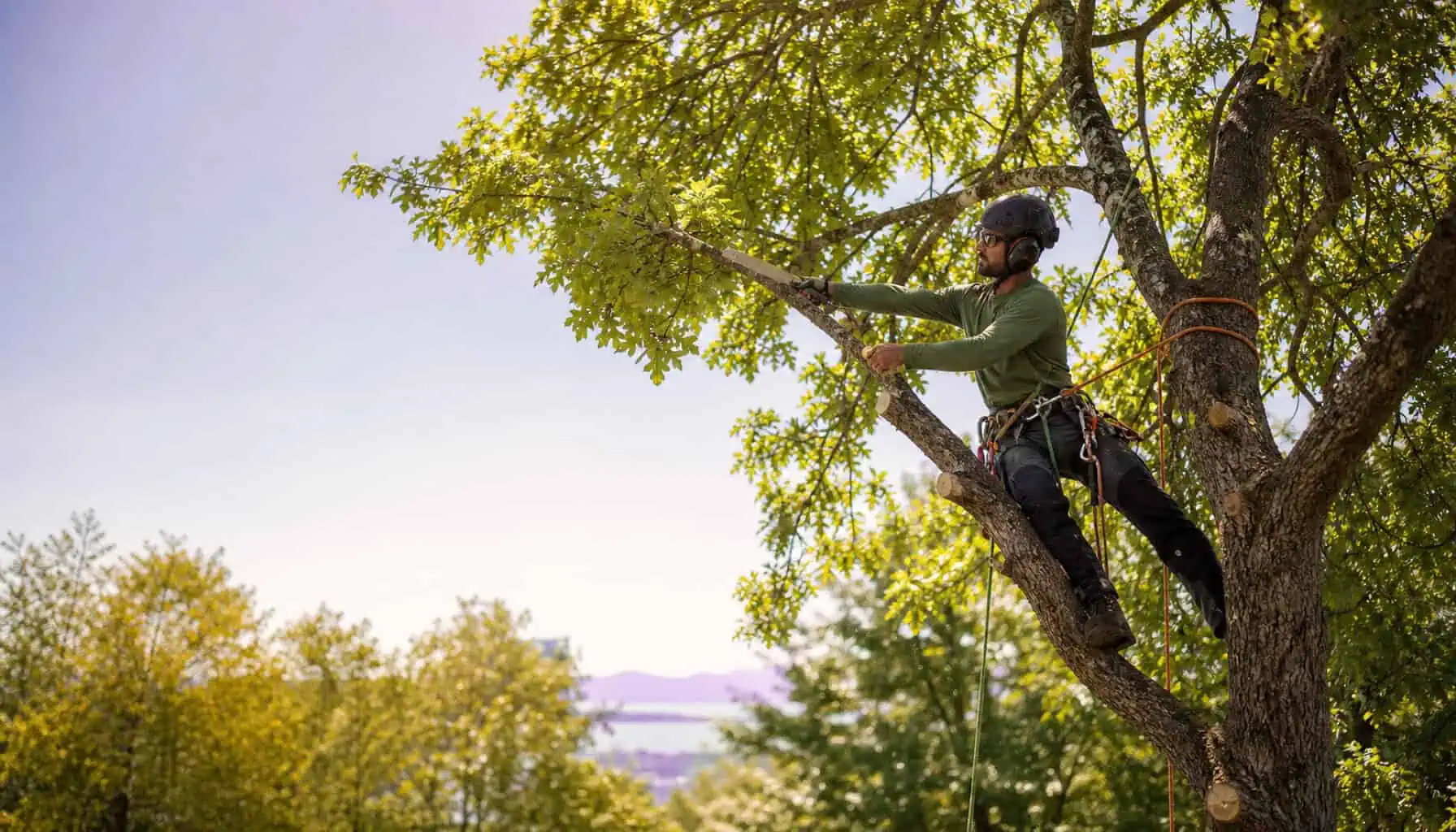
Real people in helmets, saddles and ropes rigged right. Safety culture photographs surprisingly well.
The reviews
Surfaced quotes mentioning storm response and careful cleanup, the two things neighbors actually ask each other about.
Put these four on the homepage and the estimate request stops feeling like a leap of faith. Bury them on an about page and the visitor assumes you have something to hide, because in this trade some companies do.
The 2am button and the next-morning estimate
After hours is when this trade’s most urgent money moves, so the emergency path can’t dead-end at a voicemail. We wire the call button to whatever you run at night, a cell rotation or an answering service, and back it with a short form for the scary-but-stable tree that can wait for daylight. Either way, the homeowner gets an answer while the fear is fresh. We also make the promise explicit on the button itself: answered live, around the clock, or whatever your real coverage is. A homeowner with a limb through the skylight remembers who picked up.
On the planned side, estimate speed wins: the first clear written quote usually beats the second opinion that never got scheduled. The site books assessments directly, and your map presence keeps feeding it between weather events. This build fits the insured, equipped outfit tired of losing jobs to cheaper and sketchier. Scope it with the full tree service plan on a free call. Month to month, no long contract, and about twenty minutes to find out whether it fits.
The BAO Method
A proven, transparent process, not a black box.
1. Discover
A free call to understand your goals, market and what’s holding growth back.
2. Plan
A custom plan: the exact channels you need, scoped to your budget.
3. Build & Launch
We build and launch it for you: site, campaigns and systems.
4. Grow & Report
We optimize monthly and report on the metric that matters: leads.
Why work with Business All In One
All-in-one
One partner for every channel, no juggling vendors or finger-pointing.
Done-for-you
You run your business; we run the marketing, end to end.
Industry-proven
Real results since 2017 across the trades and local services.
No lock-in
Clear scope, transparent monthly reporting, month-to-month.
Frequently asked questions
Should the insurance certificate really be on the website?
Make it effortless to see, yes. Smart homeowners are told to ask for it, and most feel awkward actually asking. Publishing it, or putting it one click away, removes the awkwardness and quietly flunks every competitor who can’t match it. A current certificate also signals current coverage, which lapses in this trade more often than homeowners would guess.
Do crane and heavy equipment photos scare homeowners off?
The opposite. The machine says the removal is routine for you, and a well-documented crane job also explains the price you charge. What scares homeowners is picturing a guy free-climbing their oak with a saw. Show the machine working over a real house, not parked in a yard.
Do I need a separate emergency page?
Yes. A tree through the roof is its own search, and the page that answers it needs almost nothing except reassurance, a number and what happens when you arrive. It also gives your after-storm ads somewhere honest to land. Keep it short, because panic does not scroll.
People always ask what a removal costs. What should the site say?
Explain what moves the number, size, access, hazards, how close the house sits, and offer a fast assessment instead of a blind guess. Honest factors plus a quick visit beat a figure that would’ve been wrong anyway. It also saves your estimator from driving to jobs the caller never meant to book.
What is the site doing between storms?
Selling the planned work: pruning, cabling, stump grinding, tree health. Fall is for storm-prep assessments and spring is for the removal list. The emergency machinery stays in place, waiting on the weather. Those pages also carry the reviews and photos that storm customers go check later.
Related
Sites are built to pass Core Web Vitals and to meet Google’s page experience guidance.
Ready to grow?
Book a free, no-pressure discovery call. We’ll map the right plan for your business in about 20 minutes.