
Marketing Tips
Boosted Post vs Facebook Ad: Which Actually Gets Leads
Both are the same auction. The difference is what you’re allowed to ask Meta to go and get, and that single setting decides whether you buy likes or booked jobs.
In short:
A boosted post and a Facebook ad are both paid ads in the same auction. The difference is what you’re allowed to tell Meta to go and get. Boosting hands you a short list of objectives built around engagement, while Ads Manager lets you choose leads, calls or purchases and optimize for them. If you want likes, boost. If you want the phone to ring, open Ads Manager.
Almost every small business owner has pressed Boost at least once, and a good number of them have quietly concluded that Facebook advertising doesn’t work for their business.
It usually went something like this. You posted a decent photo of a finished job. It got a few more likes than usual, so Facebook offered to show it to more people for twenty dollars. You paid. Reach went up, a handful of likes came in, one comment from a supplier, and not a single phone call. So you decided paid social was a waste of money for a business like yours.
That conclusion is understandable and almost always wrong. The problem wasn’t Facebook, the audience or the photo. It was that you paid for engagement and then judged the result on booked jobs. Those are two different products, and the Boost button sells the first one by default.
The boosted post vs Facebook ad question is really a question about objectives, and once you see that, the answer stops being a matter of opinion. This is a comparison of what each option actually is, what each one costs to test properly, and how to decide between them for a local service business. There are real numbers in here, because most articles on this subject carefully avoid them.
What pressing Boost actually does
Boosting is not a lesser thing than advertising. It is advertising. When you press Boost, Meta creates a real campaign in the same auction that every other advertiser competes in, using the same inventory and the same bidding. Nothing about the underlying machinery is different.
What is different is the control panel. Boost gives you a handful of settings on one screen: a goal, an audience, a budget, a duration. Ads Manager gives you the full campaign structure, which is roughly forty decisions across three levels. Meta built Boost so that a business owner can spend money in ninety seconds without learning any of that.
The catch sits in the goal menu. Boost’s options are built around cheap, plentiful actions: more engagement, more views, more messages, more profile visits. Meta will deliver exactly what you select. If you pick more engagement, the algorithm goes looking for the people most likely to tap a like button, because that’s the outcome you bought.
People who reliably tap like buttons are not the same people who are about to pay for a new roof. There’s some overlap, but the algorithm isn’t aiming at the overlap. It is aiming at the metric you chose.
That is the whole misunderstanding, and it explains the outcome almost every owner describes. The boost worked. The reach was real, the likes were real, the money bought precisely what was ordered. It just wasn’t leads, because leads were never on the menu you were looking at.
It’s worth knowing why the button exists at all. Organic reach on a business page has collapsed over the past decade, and a post to a page with 800 followers now typically reaches a small fraction of them. Meta put Boost directly under every post because that’s the moment an owner notices the drop and is most willing to pay to fix it. The button is well designed for Meta’s purposes. That doesn’t make it the wrong tool, but it does explain why it’s the first one you see and the full campaign builder isn’t.
What you give up when you press Boost
Most of the boosted post vs Facebook ad difference comes down to this list. Five controls disappear when you take the shortcut. Each one matters more than it sounds.
- The objective. The big one. Ads Manager lets you choose Leads or Sales and hand Meta a conversion event to chase. The algorithm then spends your budget finding people who complete that event. Boost cannot do this, so it optimizes for the closest cheap proxy instead.
- Placements. Ads Manager lets you decide where your money goes: Facebook feed, Instagram feed, Reels, Stories, Audience Network, Messenger. Boost spreads across them. For a local service business, some of that inventory converts badly, and you’re paying for it either way.
- Audience precision. Boost gives you age, gender, location and broad interests. Ads Manager adds custom audiences from your customer list, website visitors, video viewers and lookalikes built from people who already paid you. That last category is usually the best-performing audience a local business has, and Boost can’t reach it.
- Creative testing. In Ads Manager you can run four versions of an ad against each other and let the data pick. Boosting promotes one post as it exists. If the photo is the problem, you will never find out.
- Useful reporting. Boost reports reach, engagement and cost per result, where the result is whatever proxy it optimized for. Ads Manager reports cost per lead, cost per purchase and return on ad spend, tied to conversion events on your site.
Most of these are recoverable. You can always move to Ads Manager later. The one that is not recoverable is the money already spent, and the conclusion you drew from it.
Boosted post vs Facebook ad, side by side
The practical differences, with the numbers most comparisons leave out.
| What matters | Boosted post | Ads Manager |
|---|---|---|
| Objectives | Engagement, views, messages, profile visits | Leads, sales and calls, with a conversion event to optimize against |
| Setup time | About 90 seconds | Half a day the first time, then under an hour |
| Realistic daily budget | $5 to $10 a day | $20 to $30 a day for conversion campaigns |
| Minimum useful run | 5 to 7 days | 14 days, so the algorithm can exit the learning phase |
| Audiences | Age, gender, location, broad interests | All of that plus customer lists, site visitors and lookalikes |
| Creative testing | None, it promotes the post as published | Multiple versions tested against each other |
| What you learn | Whether people engaged | What a lead cost you, and which audience produced it |
| Best for | Awareness, events, amplifying a post that already worked | Anything that has to produce booked work |
What each one actually costs to test
Every comparison of these two options avoids this question, which is strange, because it is the only one an owner is really asking. Here are working numbers.
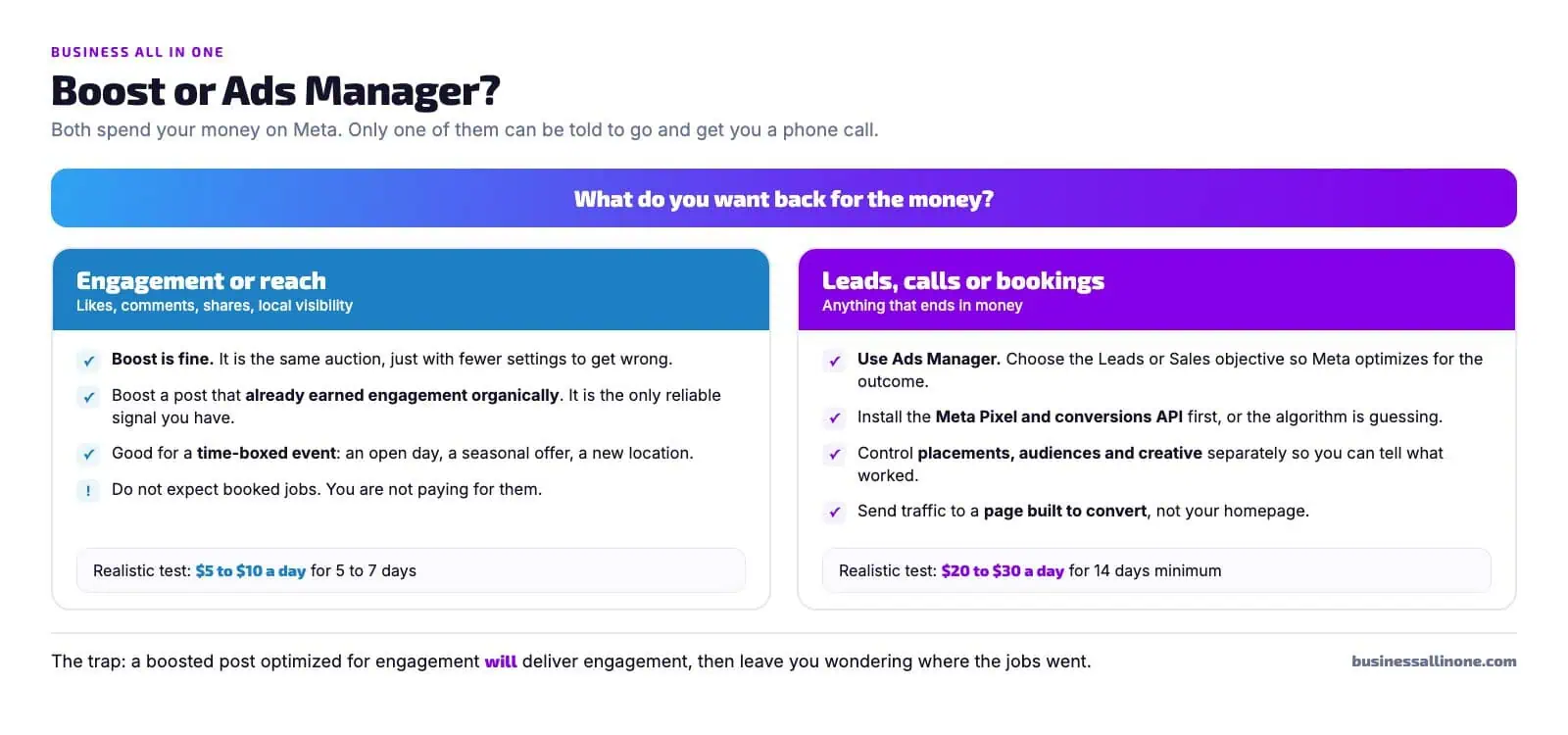
A boost costs $5 to $10 a day for five to seven days. Call it $35 to $70 for a genuine test. Below about $5 a day you won’t buy enough impressions to learn anything, and the result will be noise you can’t read either way. That budget buys you an answer to one question: does this piece of content interest people in this area? It’s a content test, not a lead test.
A conversion campaign needs $20 to $30 a day for at least fourteen days. Call it $280 to $420 for a first real test. That floor is not arbitrary. Meta’s algorithm has a learning phase, and it needs roughly fifty conversion events a week before delivery stabilizes. If your cost per lead is $25 and you’re spending $10 a day, you’ll generate about three leads a week and the campaign will never leave learning. You’ll pay the full price and get the worst version of the product.
The learning phase isn’t a penalty Meta invented to extract more money. Delivery systems need a volume of outcomes before they can identify a reliable pattern, and until they have it, they’re spending your budget on educated guesses. Fifty events a week is roughly where the guessing stops. Fund below that and you pay for the guessing without ever reaching the part where it works.
This is the most common and most expensive mistake in small business paid social. Not spending too much. Spending too little, for too short a time, and concluding the channel doesn’t work.
There’s one more line most owners don’t see coming. Plenty of agencies charge a percentage of ad spend, typically 10 to 20%, on top of a management fee. That model quietly rewards the agency for persuading you to spend more, which is not the same as rewarding them for getting you more work. Worth asking about before you sign anything. We don’t charge on spend at all, which is why our Facebook and Meta ads management is included rather than metered.
When boosting is genuinely the right call
Boosting has a real job. It is just a narrower one than the button implies.
Boost when:
- A post has already earned engagement organically. That is the only honest signal you have that the content is good, and boosting amplifies something proven rather than gambling on something untested.
- You’re promoting a time-boxed event: an open day, a grand opening, a seasonal offer with an end date. Awareness is the actual goal, so the objective matches.
- You want local familiarity in a small service radius. Being recognized in a town of twelve thousand has value that won’t show up as a tracked lead.
- You have under about $50 to spend and no tracking installed. At that budget a conversion campaign can’t work properly anyway, so the simpler tool is the honest choice.
Use Ads Manager when:
- The campaign has to produce leads, calls or bookings you can count.
- You want to reach past customers or people who visited your site, which is usually the cheapest work you’ll ever buy.
- You need to know which audience or which photo produced the result, so next month’s budget goes somewhere smarter.
- You’re spending more than about $500 a month, where the lost efficiency costs more than the time to learn the tool.
Notice that these lists are not opposites. Plenty of businesses should be doing both: boosting the occasional post that is genuinely resonating, while a conversion campaign runs underneath doing the actual work.
A worked example: one plumber, $600
Abstract comparisons are easy to nod along to and hard to act on. So here is the same money spent two ways, using numbers that are ordinary for a local trade in a mid-sized market.
A plumber has $600 for the month. Average job value is $450. He converts about half the qualified calls he gets.
Option one, boosting. He boosts three posts at $200 each across the month, each running about a week. Say $12 per thousand people reached, which the industry calls a $12 CPM and which is normal for a local audience. That’s roughly 50,000 impressions over the month, and at a 1% engagement rate around 500 interactions. Most are likes. A handful are comments, one or two are messages. Suppose two of those messages turn into quotes and one becomes a job. That’s $450 of work for $600 of spend, and no information about which post, which audience or which photo did it.
He might do better than that. He might do worse. The point is he cannot tell, because he never bought the measurement.
Option two, a conversion campaign. He spends $20 a day for thirty days, same $600. The objective is Leads, the Pixel is installed, and the traffic goes to a page about emergency repair rather than his homepage. At a $30 cost per lead he gets twenty leads. Not all are good, so say twelve are qualified, and at his usual close rate that’s six jobs. Six jobs at $450 is $2,700 from the same $600.
Those numbers are illustrative, not a promise. Cost per lead varies enormously by trade and market, and a bad landing page can wreck the whole thing. But the shape of the difference is real and it holds up across verticals, because one campaign was told to find people who tap like and the other was told to find people who fill in a form.
The second version also leaves him with something the first never does: he knows what a lead costs. Once you know a lead costs $30 and a job is worth $450, the decision to spend more stops being a leap of faith and becomes arithmetic.
What owners get wrong
The patterns we see repeatedly, in rough order of how much they cost.
- Judging a boost by the wrong metric. You bought engagement. Measuring it in booked jobs is like buying a billboard and being annoyed nobody handed you cash at the roadside.
- Running conversion campaigns on a boost-sized budget. $10 a day on a Leads objective usually performs worse than the same money on a boost, because the campaign never exits the learning phase.
- Boosting a post that flopped organically. If nobody engaged for free, paying to show it to strangers rarely fixes it. The content was the problem.
- Sending paid traffic to the homepage. Someone who clicked an ad about drain cleaning should land on a page about drain cleaning. A homepage makes them go looking, and most won’t.
- No tracking at all. Without the Pixel and a conversion event, Meta is guessing and so are you. This is the cheapest thing on the list to fix and the most frequently skipped.
- Stopping after nine days. Fourteen days is the floor for a conversion campaign. Turning it off in week one and declaring failure is the most expensive form of impatience in small business marketing.
Frequently asked questions
Is it better to run a Facebook ad or boost a post?
The boosted post vs Facebook ad decision comes down to what you want back. If you want leads, calls or bookings, run the ad through Ads Manager, because only there can you choose a conversion objective and have Meta optimize for it. If you want engagement or local awareness on a post that’s already doing well organically, boosting is the simpler tool and there’s nothing wrong with it. The mistake isn’t choosing boost, it’s choosing boost and then expecting leads.
What are the disadvantages of boosting a Facebook post?
You lose five things: the ability to choose a conversion objective, control over placements, precise audiences like customer lists and lookalikes, creative testing, and reporting tied to actual conversions. You also can’t easily tell why something worked, which means you can’t repeat it. Boosting is fast and simple, and you pay for that convenience in control and in what you learn.
What are the advantages of boosting posts?
Speed and simplicity, mainly. A boost takes about ninety seconds and needs no technical setup, no Pixel and no landing page. For amplifying a post that already earned engagement, promoting a time-limited event, or building local familiarity on a small budget, that’s a fair trade. It is also the more honest choice under about $50, since a conversion campaign can’t work properly at that spend anyway.
Can a boosted post go viral?
It can spread, but boosting doesn’t cause virality. Paid reach shows your post to people you paid to reach, and if they share it you get organic reach on top. What actually spreads is content people want to pass on, and boosting only amplifies whatever the post was already going to do. A boost applied to unremarkable content buys reach and stops there.
Can Facebook ads increase followers?
Yes, and there’s a specific objective for it, but think about whether followers are what you need. For a local service business, a follower who never books is worth very little, while a lead who books once and refers a neighbor is worth several hundred dollars. Follower growth is a reasonable secondary goal and a poor primary one.
Should I boost on Instagram?
The same logic applies, since both run through Meta’s ad system. Instagram tends to suit visual trades better, so landscapers, remodelers, med spas and anyone with strong before-and-after work usually see more from it than a plumber does. Whichever platform you use, the objective question doesn’t change: engagement buys engagement, and leads have to be asked for directly.
The short version
The boosted post vs Facebook ad choice is not about two products. Both are the same auction with different steering. Boost gives you a small set of goals built around engagement, and Meta delivers whichever one you pick, faithfully and literally. Ads Manager lets you ask for what you actually want, which for a local service business is a phone call.
That’s why so many owners conclude Facebook doesn’t work for their trade. They asked for likes, got likes, then measured the result in jobs. The channel did exactly as instructed.
If you take one thing from this, make it the budget floor. A boost needs $5 to $10 a day for about a week. A conversion campaign needs $20 to $30 a day for at least fourteen days. Underfunding the second is the costliest error available, because you pay for a result that was never achievable at that spend, then conclude the channel doesn’t work.
Once you know what a lead costs and what a job is worth, the rest is arithmetic rather than instinct. Getting to that number is the point, and the Boost button is not the road there.
Want your ad budget pointed at booked jobs?
We run Google and Meta campaigns as part of one plan, and we do not charge a percentage of your ad spend, so you keep the budget working for you. Free discovery call, custom quotes, no lock-in. Or call 857-574-5308.